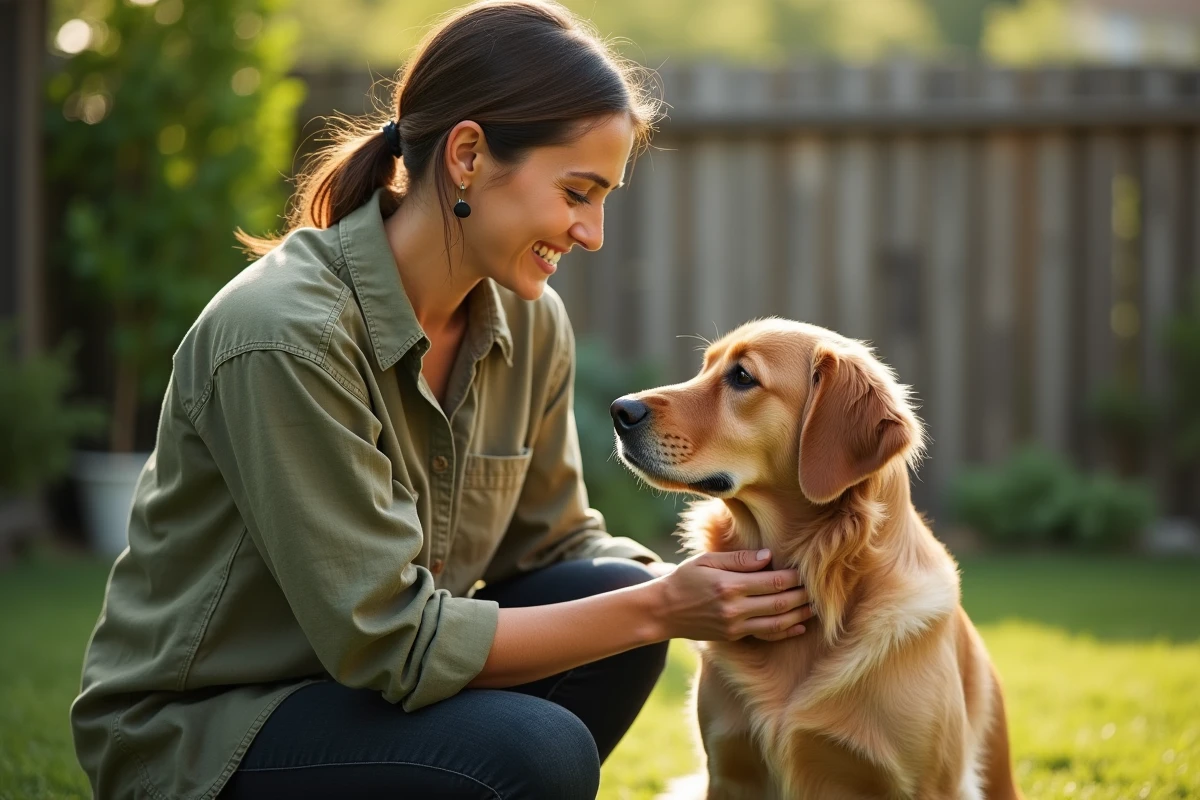
Your dog pulls on the leash, barks at guests, or ignores the recall in the park. These everyday situations do not indicate a difficult character. They signal a gap between what you expect and what your dog understands. Kind dog training starts from this observation to build a relationship based on mutual understanding, not on constraint.
Canine communication signals: what your dog is telling you before acting
Have you ever noticed that your dog turns its head away when you stare at it? This seemingly innocuous gesture is a calming signal. Dogs communicate constantly through postures, ear movements, yawns, or nose licking.
Before jumping, growling, or fleeing, a dog sends a sequence of subtle signals. A stiffening body, a fixed gaze, a low tail: these are all signs that the situation makes it uncomfortable.
Reading these signals prevents most conflicts in daily life. Growling, for example, is not an act of aggression. It is a clear warning. Punishing it means removing the alarm without addressing the problem. The dog then learns to bite without warning.
Careful observation of your pet in daily life, during walks and at home, allows you to identify its tolerance thresholds. Each dog has different comfort distances when it comes to other animals, noises, or handling. Respecting these is already a form of kind education. You will find additional resources about dogs on Syntonie Animale to deepen this behavioral reading.
Positive reinforcement in dog training: how it works in practice
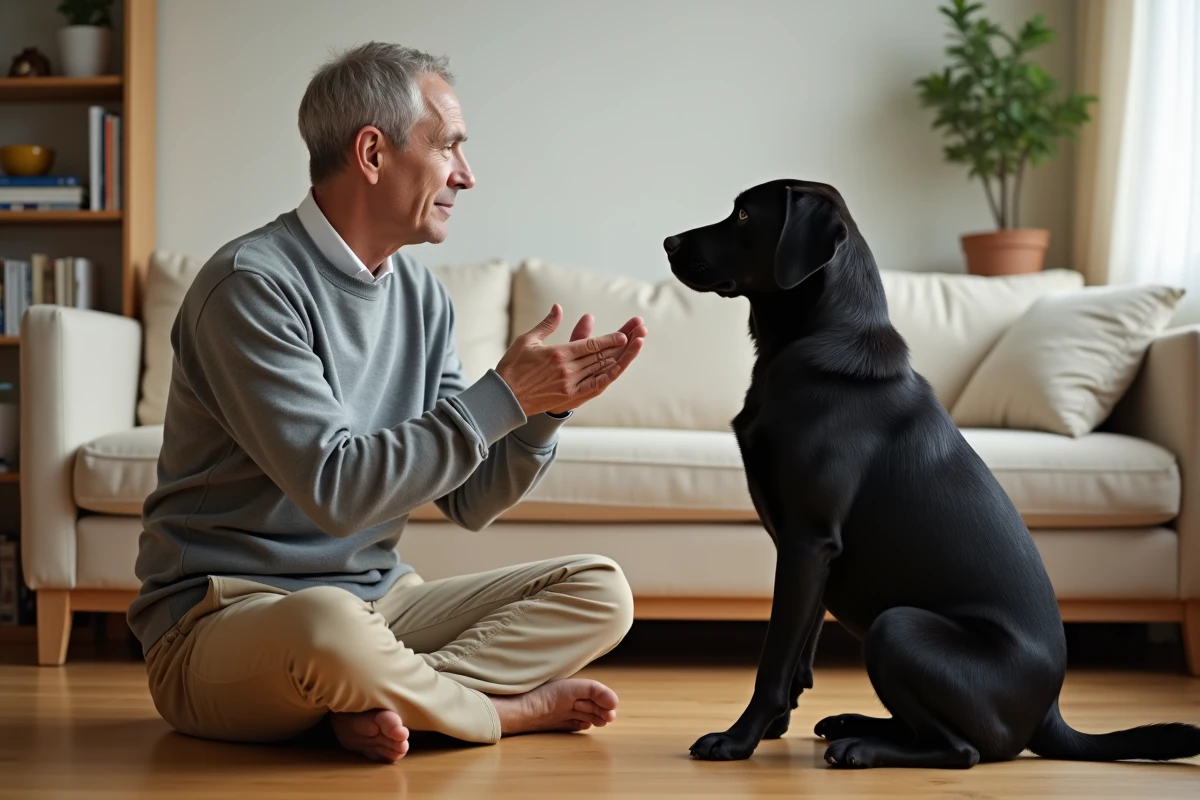
The principle is simple. When a behavior produces a pleasant consequence, the dog repeats it. A treat, a pet, a game, or simply your attention: the reward reinforces the desired behavior.
Let’s take a concrete example. Your dog sits by itself when you prepare its bowl. You place the bowl on the floor. The dog has just learned that sitting calmly gives access to food. No command was necessary.
What positive reinforcement is not
This approach does not mean letting everything slide. A clear framework is still necessary for the safety of the dog and its surroundings. The difference lies in the method used to establish this framework.
Instead of punishing an unwanted behavior, we redirect the dog’s attention to a compatible behavior. A dog that jumps on visitors? We teach it to fetch a toy when the doorbell rings. The jumping disappears because it is replaced, not because it is punished.
- Ignore the unwanted behavior when it poses no danger (the dog begging at the table will eventually stop if no one gives in).
- Offer an incompatible alternative: a dog lying down cannot jump. Rewarding the lying down is enough to solve the problem.
- Adapt the environment: putting shoes out of reach during the learning phase prevents putting the puppy in a situation of failure.
Coercive collars and punitive methods: why abandon them
Since 2023, the Federation of Veterinarians of Europe (FVE) explicitly recommends abandoning electric shock collars, choke collars, and prong collars. These tools increase the risk of anxious behaviors and redirected aggression.
The mechanism is straightforward. The dog associates pain with the environment in which it occurs. An electric collar activated when the dog encounters another animal does not teach it to remain calm. It teaches it that the presence of a fellow creature predicts pain. Aggression towards other dogs worsens.
In France, the status of a living being endowed with sensitivity, enshrined in the Civil Code since the law of February 16, 2015, reinforces this position. The use of violent methods under the guise of education can now be prosecuted as abuse.
The question of timing
Punishment also poses a problem of understanding. For a dog to make the connection between its action and the consequence, the latter must occur within a second. Scolding a dog that has destroyed a cushion in your absence produces no learning. The guilty look you observe is a response to your threatening tone, not a sign of guilt.
Human-dog relationship and stress management: what research shows
Recent studies indicate that dogs with a secure relationship with their owner have lower cortisol (stress hormone) levels in new situations.
Specifically, a dog whose owner adopts a calm and predictable attitude explores more, recovers faster after a scare, and cooperates better during learning. The quality of the relationship conditions the dog’s learning ability.
Have you ever noticed that your dog is more agitated on days when you are stressed? This is not a coincidence. The dog perceives variations in your emotional state through smell and micro-body expressions. Working on your own calm during training sessions produces measurable results.
- Keeping sessions short (a few minutes is enough for a puppy) maintains motivation and avoids frustration on both sides.
- Always ending on a success, even a small one, anchors a positive association with the learning moment.
- Varying training contexts (home, garden, quiet street) helps the dog generalize learned behaviors.
A dog that feels safe learns faster than a dog that is afraid of making mistakes. This principle guides the entire kind approach to dog training. The goal is not to train an obedient animal out of fear, but to build a partnership that works daily, respecting the needs of each.