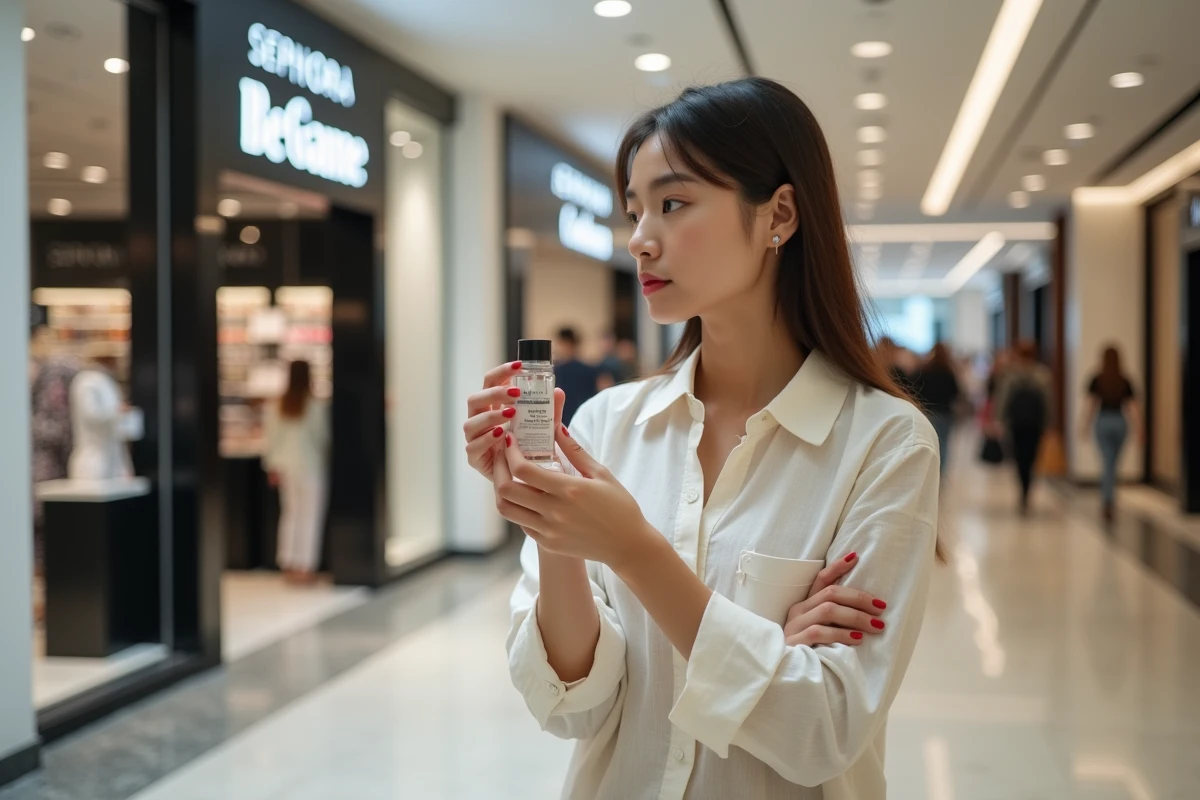
Typology is among the most sought-after skincare brands in France, yet it remains absent from Sephora’s shelves. This situation regularly surprises consumers accustomed to finding popular clean beauty brands in major retailers. The explanation is not due to a commercial dispute or a quality issue: it stems from a distribution choice made by Typology since its inception.
Typology’s direct-to-consumer model: what it changes for price and formulation
Typology has built its business on a single channel: online sales through its own website. This direct-to-consumer (DTC) model eliminates intermediaries between the brand and the customer. In practical terms, the absence of a third-party distributor allows Typology to set its prices without including a retailer’s margin.
This choice has a direct consequence on the formulations. When a brand goes through a network like Sephora, it must adapt its packaging, volumes, and sometimes its compositions to meet the distributor’s requirements. Typology maintains total control over its formulations and packaging, aligning with its minimalist positioning: few ingredients, short INCI lists, and a claimed transparency regarding each component.
To better understand the relationship between Sephora and Typology, one must look beyond the simple issue of availability and examine the economic logic behind this absence.
The DTC model also provides direct access to customer data. Typology collects feedback on each product, analyzes skincare routines through its online diagnostic, and adjusts its catalog accordingly. A retailer like Sephora centralizes this data and does not systematically share it with the brands it hosts.

Sephora and its selection criteria: why some clean brands remain outside
Sephora is not just a display. The distributor selects its brands based on specific criteria: guaranteed production volumes, the ability to supply the entire network (several hundred points of sale in France), a marketing budget dedicated to in-store promotions, and margins compatible with its cost structure.
For a brand like Typology, meeting these requirements would involve several adjustments:
- Increasing production volumes to supply a dense physical network, with the risk of overstock or stockouts depending on the references
- Financing in-store promotional activities (testers, events, training beauty advisors) that increase the cost per unit sold
- Accepting a distributor margin that would impact the final price or the brand’s profitability
This model contradicts Typology’s positioning. The brand relies on affordable prices thanks to the absence of intermediaries. Integrating Sephora would either require raising prices or reducing the quality of ingredients to maintain margins.
The case of The Ordinary as a point of comparison
The Ordinary, often compared to Typology for its transparent approach and accessible prices, made a different choice. The Canadian brand has been available at Sephora for several years. This physical presence has accelerated its notoriety, but The Ordinary is part of the Estée Lauder group, whose logistical and financial power allows it to absorb the constraints of retail.
Typology, an independent structure founded by Ning Li, does not have the same backing. The capital independence of Typology conditions its distribution model.
Pop-up stores and Printemps Haussmann: Typology’s selective physical strategy
The absence from Sephora does not mean a total rejection of physical commerce. Typology has experimented with ephemeral pop-up stores in independent concept stores, particularly in Paris and Lyon. These operations allow testing in-store demand without permanent commitment or dilution of brand image.
The brand also has a corner at Printemps Haussmann in Paris, its only permanent physical point of sale in France. This choice is not trivial: Printemps positions its beauty space in a premium and selective segment, in contrast to Sephora’s mass model.
This hybrid approach offers measurable advantages. A pop-up store generates local visibility and direct customer feedback, without the fixed costs of a network of boutiques. The corner at Printemps provides a physical showcase for consumers who want to test textures and scents before buying online.
European cosmetic regulation and the complexity of retail partnerships
The update of the European Union’s cosmetics regulation strengthens traceability and testing requirements for third-party suppliers. For a brand focused on total transparency of formulations, increasing distribution intermediaries adds a layer of regulatory complexity. Each retail partner imposes its own compliance protocols, which increases the administrative burden.
By maintaining a short supply chain, Typology simplifies this control process. The brand masters the entire journey, from formulation to delivery to the final customer.

Typology facing international scalability without Sephora
Typology’s DTC model is not limited to the French market. The brand has seen significant growth in its online sales internationally, particularly in Asia. This digital expansion avoids the logistical costs associated with establishing in foreign physical retailers.
In contrast, clean beauty brands like Jones Road have chosen to open their own stores in the United States and the United Kingdom. The two strategies coexist, but Typology favors digital export to preserve its margins.
This positioning has a limitation: the sensory experience. Skincare products remain items that many consumers prefer to test before purchasing. Feedback from independent concept stores that have featured Typology indicates a stock turnover higher than average, a sign of real physical demand.
Thus, the absence from Sephora is not a barrier to growth, but it requires Typology to continue investing in its website, its online diagnostic, and its occasional physical operations to compensate for the lack of in-store touchpoints. The model holds as long as digital loyalty compensates for the absence of a retail showcase.