The new “furniture culture” inaugurated by the Danish Kaare Klint.
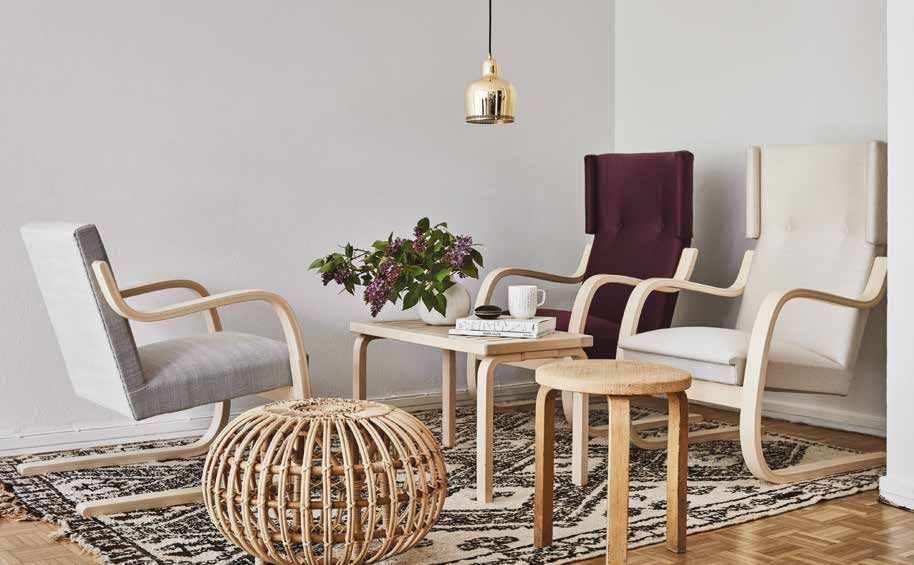
in the image Armchair 401 and Armchair 402, 1933. Design Alvar Aalto for Artek.
Between the two extremes in furniture design of the interwar period, the high cabinetry of Ruhlmann and the aseptic modernism of Le Corbusier and the Bauhaus designers, there was a middle ground.
This was happily navigated by Kaare Klint, the one who gave birth to the Scandinavian style. The Dutch designer became popular in the 1930s and, after 1945, he “rose” in Europe and North America.
With his work, he managed to capture the kind of common thread that runs through the entire “furniture culture” conceived as autonomous, not subject to styles and trends.
Klint selects and develops typologies from the past by translating them into a purely modern morphology, a kind of redesign, in the best sense of the term, which is very current: a middle ground between pure historical eclecticism and the most irrational fantastic futures. While Klint’s style is based, besides history, particularly on anthropometry, that of another of Denmark’s most important designers, the young Finn Juhl, is based on contemporary experiences of abstract art and particularly on anthropomorphism.
Other precursors of Nordic design include Carl Malmsten, Bruno Mathsson, Børge Mogensen, Hans Wegner, Arne Jacobsen, Erik Gunnar Asplund, Alvar Aalto. The production element of Scandinavian design descends directly from the project, to the point of being called “mechanized craftsmanship.”
Without presenting any particular innovations, it is based on curvature, wood turning, and the bending of plywood which allows for new shapes that can be derived from a single sheet and thus maintain a certain continuity combined with the elasticity of the product.
The sales component, although reaching maximum quantification, rather shifts from popular consensus, from “consumption”; based on this, it establishes particular systems, advocating modes and times of “production” until they reach and even influence design. The Swedish consumer association KF created its own architecture office, a furniture consulting firm, and carpentry workshops. Additionally, it created schools, laboratories, and libraries.
All this seems to correct the distortions caused by profit-driven economics, overturn the production-consumption process, identify an alternative client, or at least be criticized, and finally coexist the quality of the product and a socially affordable price. But obviously, it was not enough to stabilize the fortunes of a national production that subsequently fell into crisis.

EzioraMera
Tag : create a Nordic decoration